Posts

St. Andrew's cross, Hypericum hypericoides on August 22nd
Image
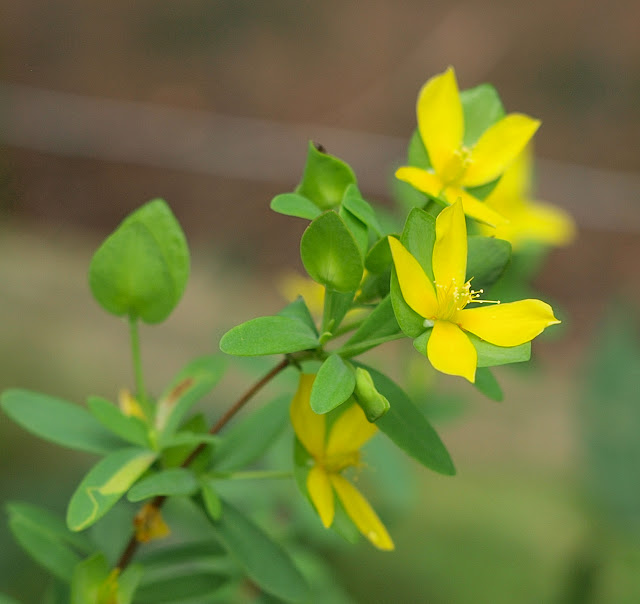
   This is a plant called St. Andrew's cross,  Hypericum hypericoides, which is a member of the St. John's Wort family Hypericum .  It is a very common plant in the Southeastern United States.   One of the main differences visually between this and St. John's Wort is that the St. Andrew's cross has four petals, placed oblong in a 'winged' fashion, while the St. John's Wort has five evenly spaced petals.  The St. John's Wort contains folk medicine qualities that some believe in, and some don't.  St. Andrew's cross was also valued by the Native Americans for it's help in fighting certain inflammations and pain.   I believe in the past I have called this a 'yellow lespedeza', if only to myself, because the leaves do resemble the lespedeza sericea.  And, it is true that there are other colors and more showy versions of lespedeza than the one that has been wilded on our hill (back more than thirty years ago, I am told).  Today, after ...
The Thistles and the Devils Walkingstick on August 21st

Image
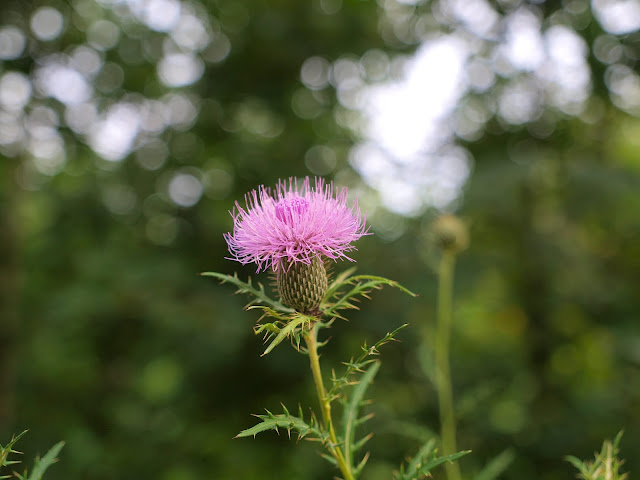
    I've been waiting for the thistles to bloom.  One of the first things that got me thinking about 'microclimate' was that our thistles weren't blooming yet - and they were elsewhere.  I looked at other things that are 'different' here on our side of Pea Ridge... and we really are one 'microclimate' away from the rest of the area.  Our Ipomoea Pendulata (woods dayblooming moonflower) is just about done - one or two blooms a day now, and the ones elsewhere are just rearing up.  Other places the Thistles are tall and purple, in our area, they are just emerging from the spiky balls they have been forming slowly over the past few weeks. Another just about to bloom and where they sat two weeks ago, when I noticed the very first flower heads beginning to emerge from the spiky nests of leaves And I'll leave you with the soft fuzzy part of the thistle - like a Dr. Seuss flower or the topknot on a fuzzy chick.  It is still amazing it can come out of all tha...

Moonflowers on August 17th and more

Image
       The moonflower seeds I planted months ago have their very first flower, and it smells wonderful.  I saw the cone starting to develop this morning, and wanted to catch a picture of it, but I forgot to.  I was distracted by the development on the Devil's Walking Stick Aralia spinosa (seen below the moonflowers)   Ipomoea alba, white moonflower Aralia spinosa, Devil's Walking Stick, Prickly Ash, Hercule's Club We call it Devil's Walking Stick around here, because of the prickly long wooden stem that hurts if you accidentally grasp it while walking through the brush later in the year.     We have passionflower vines!  It can take a while to establish them from seed.  I planted these maybe three years ago, and they must have 'took' but not done well.  This year, we found them growing happily alongside the moonflowers.  Maybe this is the year they will bloom, too?  Passiaflora caerula, blue passionflower, it says o...

Galium or Bedstraw on August 11th

Image
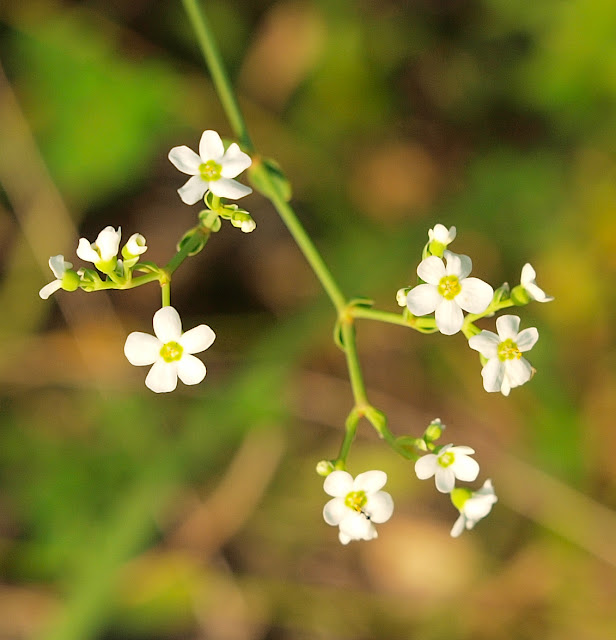
Sometimes, you've got to look twice.   There is something about this plant, and the way it emerges at this time (late July to early August, with many other butterfly plants) that made me take a second look at it today.  It looks inconspicuous, growing about a foot high on the side of the road among the grass.  The leaves reminded me of lespedeza, but the flower structure was more like baby's breath.  In days past, I would have just kept walking because it was a 'little flower'...(in fact one site called it 'green noise!' ) But - this morning, I noticed the little clusters of flowers were being visited by many small bluewing and white moths, and had many small bees and ants crawling near them.  I thought, there has to be more than meets the eye about this!   family Rubiaceae, also containing madder plants and coffee trees! best guess: Galium album, common bedstraw, heath bedstraw Galium is a very important pollinator plant in the life cycle of moths and but...

Commelina - Microclimate Under the Oak - August Ninth

Image
There is a whole microclimate living under the oak out by the hydrant.  It can be seen for something like twenty feet in any direction that the roots of plants are different, the soil moisture level is different, the insects and the fungi are different.  It is the only place in the entire yard I have ever seen this plant, and it grows back at the base of this oak every year, near the yucca and the baby's breath, the wandering daffodil bulbs and the place where the salamander stays wet under the hydrant stone.   Commelina communis - Asiatic dayflower, also known as Mouse Ears.  It is kind of easy to see how it got that nickname, despite the color! It is part of the Spiderwort family, also known as Tradescantia. It is such a brilliant blue, and yet, so small it is easy to miss, and the flowers only last for one day.  Bees and butterflies are interested in it and visit it for pollen, but it contains no nectar.  The leaves are small and blade shaped, and grow...

special find - luna moth Actias luna

Image
  I was headed up the road to capture the thistles in their pre-opening stage, and a yellow plant that I had seen - and this caught my eye.  I saw him on a piece of grass, just like this above, and was able to manuver around him to get a shot of his backside wings as well.  The fireflies were just beginning to rise and dark was imminent.  I feel like I had a special moment he just sat there quiet and let me take his picture. Find out more about Luna moths at this great resource at the University of Florida

small spotlight : Phlox near Macedonia, TN August Seventh

Image
  The closest relative to this that I have found is Phlox amoena. The other possibility is Phlox paniculata .  It is a bit in between the two and it has been noted that Phlox varieties can cross and since each plant is both male and female, it can perpetuate in the crossed form in a wild place and be a little confusing! It is definitely in the phlox family, as it is a '5 merous' flower, merosity having to do with how many parts in a wheel.. (see website above for source).  The plant finder app I used originally wanted to call it something else - Hesperis matronalis , which is part of the Brassica family, but the flower on H. matronalis is only 4 merous, and it did not have the same sort of 'clusters' of flowers ready to open as this one did.   Phlox can also wander out of gardens, perhaps decades or a century ago, and grow on it's own in the wild.  This paticular set of plants is growing 'semi-wild' on the unmowed part of a roadside under some trees near ...